
SIP trunking delivers phone calls over the internet, replacing physical phone lines with a flexible, scalable connection that lowers telecom costs. It works by connecting a business phone system to a SIP trunking provider, which routes calls to the wider phone network without requiring new hardware. Key benefits include usage-based pricing, easy scalability, simplified expansion into new markets with local numbers, consolidated infrastructure, and compatibility with existing communication platforms. When choosing a provider, businesses should evaluate coverage, call quality, compliance, integration, and support.
If your business still runs phone calls over traditional phone lines, you're paying more than you need to, and you're limited in ways you might not even realize. Businesses commonly report saving 25% to 65% on monthly telecommunication expenses when switching from traditional phone lines to SIP trunking.
SIP trunking is the technology that lets you make and receive calls over the internet instead - and for most growing businesses, it's the difference between a phone system that scales with you and one that holds you back.
Here's what it is, how it works, and what to look for if you're evaluating it.
What is SIP trunking?
SIP trunking is a method of delivering business phone calls over an internet connection using the Session Initiation Protocol (SIP), it replaces physical phone lines with a virtual connection that carries voice calls over your internet connection.
Instead of paying for a fixed number of copper lines running into your office, you get a flexible pool of calling capacity that you can scale up or down as your business needs change.
Think of it like the difference between owning a fleet of company cars and using a car-sharing service. With traditional phone lines, you own (and pay for) a fixed number of connections whether you're using them or not.
How SIP trunking works
SIP - the technical standard used to set up, manage, and end a voice call over the internet. A "trunk" is simply the connection carrying multiple calls at once, the same term used for traditional phone lines.
In practice:
- Your business phone system (cloud PBX, unified communications platform, etc.) connects to a SIP trunking provider instead of a physical phone line.
- Calls travel as data over your internet connection rather than through dedicated copper wiring.
- The provider connects those calls to the wider phone network, so you can call - and be called by - any phone number, anywhere.
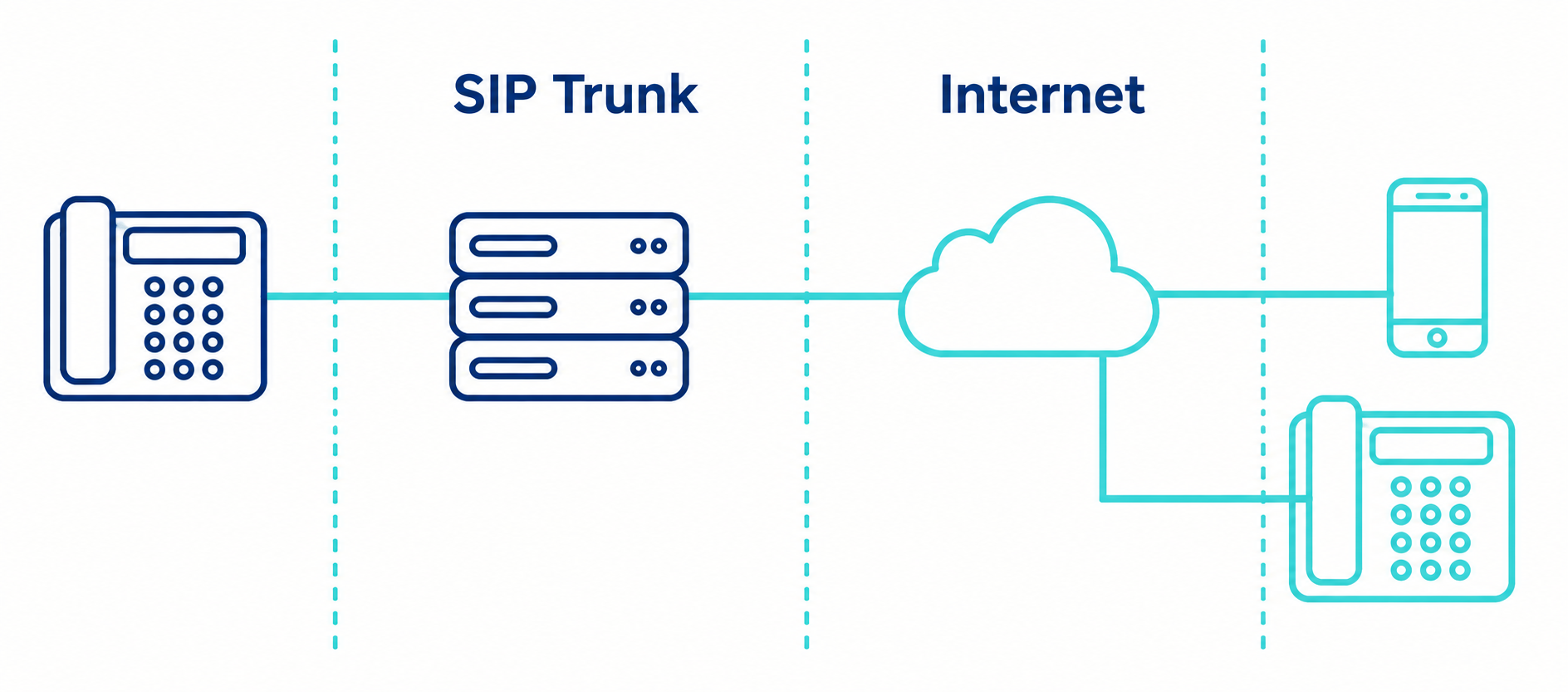
No new hardware runs through your walls. No engineer needs to install physical lines. The setup lives in software and configuration, which is a large part of why it's faster and cheaper to change than a traditional setup.
Why businesses are switching to SIP trunking
- Lower costs: Traditional phone lines charge you for capacity you may not use, especially outside business hours or during slow periods. SIP trunking is typically priced around actual usage, so you're not paying to keep idle lines connected.
- Room to scale up or down without a truck roll: Adding capacity for a busy season, a new hire, or a new office location is a configuration change, not a hardware install. The same goes for scaling down - you're not locked into infrastructure sized for your busiest month.
- Easier expansion into new markets: If you want a local phone number in another city or country so customers there can reach you at local rates, that's something SIP trunking makes straightforward - no need to lease physical infrastructure in that location.
- One connection, less to manage: Consolidating your voice traffic onto your existing internet connection means fewer separate vendors, fewer physical lines, and typically simpler IT overhead.
- Works with the tools you already use: SIP trunking is built to connect to modern cloud PBX and unified communications platforms like 3CX, Yeastar, Microsoft Teams, etc. - so it fits into infrastructure you're likely already running rather than requiring you to rip anything out.
What to check before you choose a provider
Not all SIP trunking providers are the same, and the differences matter once you're relying on it for business calls. Some things worth asking about:
- Coverage: Where does the provider actually offer phone numbers and connectivity? If you operate internationally or plan to, check that coverage matches your footprint. It’s also worth looking at the provider’s licenses, whether they have their own number ranges, and whether it can offer connectivity in harder-to-reach or less commonly covered locations.
- Call quality and reliability: Ask about uptime commitments and how the provider handles call quality, since voice traffic is more sensitive to network issues than most other data.
- Compliance: Depending on where you operate, there may be local regulatory requirements around phone numbers that vary by country. It’s worth confirming these requirements upfront, rather than discovering them after signing up.
- Integration: Confirm the SIP trunk service works seamlessly with the PBX or communications platform you already use, or plan to use.
- Support: Voice is often mission-critical, so it is essential that a provider offers 24/7 support. Check that some form of support is available around the clock - it’s especially critical when issues arise outside standard business hours.
Why over 7000 businesses choose DIDWW
DIDWW is licensed voice infrastructure - not a reseller renting someone else's network, but the operator directly holding the licenses and number blocks that keep businesses connected in 90+ countries. That's the difference between connectivity that's dependable and connectivity that just claims to be.
INVADE shows what that looks like in practice. Its predictive dialing platform powers market researchers in 50+ countries, scaling from small teams to operations running more than 1,000 interviewers - and at that range, voice connectivity can't be a weak link. It has to hold up whether you're placing ten calls a day or ten thousand.
That's what DIDWW's SIP trunks deliver: connectivity that scales with INVADE rather than around it, backed by a network DIDWW owns end to end - so call quality and uptime don't depend on someone else's infrastructure decisions.
"DIDWW has helped to facilitate our migration from on-premise to the INVADE 'Dialler as a Service' model by making it simple and cost effective for us to manage all of our client's SIP requirements in-house." - shared Mark Baker, the CEO of INVADE.
Running on DIDWW's own global network, INVADE gets virtually unlimited call capacity, flexible trunk configurations, and premium audio quality as standard - so wherever their research takes them, the connection behind it just works.
Lower costs. Simpler infrastructure. Reliable communications that scale across markets.
That’s the advantages of SIP trunking - and what DIDWW enables businesses like INVADE to achieve on a global scale.
Conclusion
SIP trunking turns business phone calls into something flexible, scalable, and easier to manage than traditional lines - and the benefits go well beyond just cost.
With SIP trunking, businesses gain the ability to scale capacity up or down instantly, without waiting on hardware installs or truck rolls. Expanding into new markets becomes simpler too - local numbers can be added wherever your customers are, without leasing physical infrastructure in each location. Because voice traffic runs over your existing internet connection, there's less to manage overall: fewer vendors, fewer physical lines, and a communications setup that fits cleanly into the cloud PBX or unified communications platform you're already using.
The result is a phone system built for how modern businesses actually operate - global by default, responsive to demand, and free from the rigid constraints of copper lines.
If your current setup is costing more than it should, buckling under growth, or holding back your expansion into new markets, SIP trunking is must-switch.
DIDWW provides one SIP trunking solution - inbound and outbound, built to keep call quality steady and downtime out of the picture. DIDWW offers premium voice routes through carrier-grade infrastructure with 99.998% uptime, plus local coverage in 55+ countries. SIP trunks can be configured to match how your business actually operates - with no vendor lock-in and native integrations with platforms like ElevenLabs, Retell AI, Vapi, Microsoft Teams, and Genesys. As a fully licensed global telecom operator, DIDWW keeps everything running on infrastructure you can rely on. For more information, feel free to reach out to our sales team at sales@didww.com or start a live chat anytime - we’re available 24/7/365.